
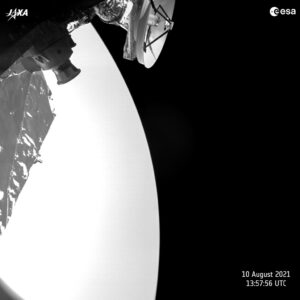

BepiColombo reaches Mercury: A Proven Milestone in Space Exploration
 by James Jackson · November 22, 2026
BepiColombo reaches Mercury after an eight-year journey, showcasing human ingenuity and perseverance in space exploration. This mission paves the way for new discoveries about our solar system’s innermost planet.
Overview of BepiColombo Mission
The BepiColombo mission, a collaborative effort between the European Space Agency (ESA) and the Japan Aerospace Exploration Agency (JAXA), has successfully reached Mercury after an eight-year journey. This landmark achievement marks a significant milestone in space exploration, providing scientists with a unique opportunity to study the innermost planet of our solar system.
Launched in October 2018, BepiColombo was designed to unravel the mysteries of Mercury, including its composition, geological history, and magnetic field. The spacecraft comprises two orbiters: the Mercury Planetary Orbiter (MPO) and the Mercury Magnetospheric Orbiter (MMO). Each of these will conduct detailed investigations to enhance our understanding of this enigmatic planet.
Key objectives of the BepiColombo mission include:
- Mapping Mercury’s Surface: High-resolution images will help scientists analyze the planet’s terrain.
- Studying the Magnetic Field: Investigations will reveal the dynamics of Mercury’s magnetic environment.
- Understanding the Planet’s Atmosphere: Unique measurements will provide insights into Mercury’s thin atmosphere.
As BepiColombo begins its operations, researchers are eager to glean valuable data that could reshape our understanding of Mercury and its role within our solar system.
Significance of Reaching Mercury
The successful arrival of BepiColombo at Mercury marks a significant achievement in the field of space exploration. This mission not only demonstrates the capabilities of modern technology but also opens up new avenues for scientific discovery.
Reaching Mercury is particularly crucial for several reasons:
- Understanding Planetary Formation: Studying Mercury will provide insights into the formation and evolution of terrestrial planets, helping scientists understand the origins of our solar system.
- Geological Insights: Mercury’s unique geological features, including its large iron core and surface composition, offer valuable information about planetary processes and differentiation.
- Magnetic Field Studies: The mission will allow researchers to investigate Mercury’s magnetic field, which is surprisingly strong for a planet of its size, shedding light on its internal structure.
- Impact on Future Missions: The data collected by BepiColombo will serve as a foundation for future exploration missions, potentially paving the way for more ambitious projects aimed at distant celestial bodies.
In summary, BepiColombo reaching Mercury is not just an end but a beginning, promising to enhance our understanding of the universe and our place within it.
Journey Timeline of BepiColombo
The journey of BepiColombo, a joint mission by the European Space Agency (ESA) and the Japan Aerospace Exploration Agency (JAXA), has been an intricate and well-planned endeavor spanning eight years. The spacecraft was launched on October 20, 2018, from the Guiana Space Centre in French Guiana. Its mission to reach Mercury began with a carefully calculated trajectory.
The timeline of BepiColombo’s voyage includes several key milestones:
- Initial Launch: The spacecraft was propelled into space aboard an Ariane 5 rocket, marking the start of its long journey.
- Gravity Assists: BepiColombo utilized gravity assists from Earth, Venus, and even Mercury itself to gain the necessary speed for its approach. These assists occurred in 2020, 2021, and 2025, respectively.
- Arrival at Mercury: After eight years of traveling through the solar system, BepiColombo successfully reached Mercury on December 5, 2025.
This timeline highlights the meticulous planning and engineering that went into ensuring BepiColombo reaches Mercury, paving the way for groundbreaking discoveries about the closest planet to the Sun.
Scientific Goals of the Mission
The BepiColombo mission, now that it has successfully reached Mercury, is poised to achieve several groundbreaking scientific goals that will enhance our understanding of the solar system. This ambitious project, a collaboration between the European Space Agency (ESA) and the Japan Aerospace Exploration Agency (JAXA), aims to explore the closest planet to the Sun in unprecedented detail.
Among the primary scientific objectives are:
- Mapping Mercury’s Surface: The mission will create high-resolution maps to reveal the planet’s geological history and surface composition.
- Studying the Planet’s Magnetic Field: BepiColombo will investigate Mercury’s magnetic field and its interaction with solar wind, providing insights into its core and internal structure.
- Understanding Exosphere Dynamics: The spacecraft will analyze Mercury’s thin atmosphere, or exosphere, to gain a better understanding of the processes that govern its composition.
- Investigating Polar Regions: The mission will examine the polar regions of Mercury, including the potential presence of water ice in permanently shadowed craters.
As BepiColombo embarks on its scientific exploration, researchers anticipate that the data collected will open new avenues in planetary science and deepen our understanding of how terrestrial planets evolve.
Challenges Faced During the Journey
The journey of BepiColombo to Mercury was not without its challenges, requiring innovative solutions and perseverance from the mission team. The spacecraft, launched in October 2018, faced a complex route that included numerous gravity assists from Earth and Venus, which were essential for slowing down enough to enter Mercury’s orbit.
One significant hurdle was the intense heat and radiation environment surrounding Mercury. As the spacecraft approached, temperatures soared, demanding advanced materials and engineering to protect sensitive instruments. The thermal shields were designed to withstand extreme conditions, ensuring that BepiColombo could operate effectively.
Additionally, the spacecraft had to navigate the intricate gravitational pulls of the inner solar system. This necessitated precise calculations and adjustments to its trajectory, a task complicated by the proximity to the Sun’s gravitational influence. Each maneuver was critical, as any miscalculation could have jeopardized the mission.
Communication posed another challenge. As BepiColombo reached Mercury, the distance from Earth made real-time communication difficult, requiring the team to rely on pre-programmed commands and automated systems to manage the spacecraft’s operations.
Despite these obstacles, BepiColombo reaches Mercury successfully, marking a significant achievement in space exploration and paving the way for groundbreaking scientific discoveries.
Future Implications for Space Exploration
The successful arrival of BepiColombo at Mercury marks a pivotal moment in the field of space exploration, opening up new avenues for scientific discovery and technological advancement. This mission not only enhances our understanding of Mercury’s unique characteristics but also sets a precedent for future interplanetary missions.
As researchers analyze the data collected from this mission, several implications are likely to unfold:
- Enhanced Knowledge: The findings from BepiColombo will provide critical insights into the formation of rocky planets, potentially reshaping our understanding of planetary development within our solar system.
- Advancements in Technology: The technologies developed for BepiColombo, including propulsion systems and communication methods, could be applied to future missions, improving efficiency and effectiveness.
- International Collaboration: The partnership between the European Space Agency and the Japan Aerospace Exploration Agency exemplifies how international collaboration can lead to groundbreaking achievements in space exploration.
- Inspiration for Future Missions: BepiColombo’s success may inspire renewed interest in exploring other celestial bodies, motivating new generations of scientists and engineers.
Overall, the successful arrival of BepiColombo at Mercury serves as a strong foundation for future exploration endeavors, encouraging further investigation into the mysteries of our universe.
What’s Next for BepiColombo?
Now that BepiColombo has successfully reached Mercury, the mission teams will shift their focus toward the next phases of exploration and data collection. The spacecraft is set to begin its extensive scientific studies of the planet, which will last for several years.
The mission aims to provide unprecedented insights into Mercury’s surface composition, geological history, and magnetic field. Key activities planned include:
- Mapping Mercury’s surface: Using advanced imaging technology, BepiColombo will create detailed maps of the planet’s surface features.
- Studying the planet’s atmosphere: The spacecraft will analyze the thin exosphere surrounding Mercury, offering clues about its formation and evolution.
- Investigating magnetic fields: The mission will measure Mercury’s magnetic field and its interactions with solar wind, enhancing our understanding of planetary magnetism.
Additionally, BepiColombo’s findings may provide valuable data that could inform future missions to other inner planets. The knowledge gained from this mission will not only enhance our understanding of Mercury but also contribute significantly to the broader field of planetary science. As BepiColombo embarks on this new chapter, the scientific community eagerly anticipates the wealth of information it will uncover.
BepiColombo reaches Mercury, marking a significant achievement in our quest to understand the innermost planet of our solar system. This mission not only showcases advanced technology but also opens new avenues for scientific discovery as BepiColombo reaches Mercury.
By europeanspaceagency via Openverse
References
Related reading

Written byJames Jackson
James Jackson is a writer and editorial contributor at socialmediacommando.com, covering news and features across the site. James focuses on clear, reader-friendly reporting.
You may also like...